
 )...
)...Thanks to Cyclerob and jfslster98 for suggestions and added input! If anybody has some more suggestions, send me a message.
Legal Disclaimer: This posting is purely for entertainment and its purpose is to dissuade all people from considering doing their own ABS service. Improper service of the brake system can cause serious damage to man and machine. Any use of the below information for any other purpose is the sole liability of the person misusing the information. The author and R1150R.net are in no way responsible for any and all bad things that may happen from the misuse of information below.
Here are some highly recommended readings. They aren't R1150R specific, but they are the sources that I used to learn about this service.
http://users.rcn.com/dehager/service/service_abs3.pdf
http://www.beachbus.net/BMW/diy/Bleed_W ... rcuits.htm
http://www.beachbus.net/BMW/diy/Bleed_C ... ircuit.htm
This is how to make a filling adapter
http://users.rcn.com/dehager/service/ab ... dapter.pdf
I wanted to have a general outline for myself when I do this service. I wanted something that basically kept me on task, and served as a checklist so that I didn't forget anything. The check list (tacked to the wall, with a pencil on a string) will be in the garage with me as I do this service in the future. I could have avoided some minor hassles, if I had such a thing in the past. Below the outline I go into detail about most of the steps taken and provided many pictures. In my instructions, I include some things that are not in the above links, which I hope will be helpful to others. The more you know going into this service, the less likely there will be problems. Read all you can, then read it all again.
EDIT August 2010--
AN ALTERNATIVE PROCEDURE for SECTIONS II and III has been added on the second page of this thread. This ALTERNATIVE PROCEDURE for SECTIONS II and III is for people who have long exceeded the specified service interval and/or whose fluid has become excessively rotten. Not only are you hard on the motorcycle...but you are hard on "iowabeakster". You owe both the bike and "iowabeakster" a super sized value meal and a Pabst Blue Ribbon.
If your bike has been regularly serviced, ignore the ALTERNATIVE PROCEDURE for SECTIONS II and III on the next page, ENTIRELY! Just follow the instructions below.
If your bike has not been serviced regularly, DO NOT follow the instructions for sections II and III in the STANDARD PROCEDURE below. Instead, use the ALTERNATIVE PROCEDURE for SECTIONS II and III, on the next page. You risk serious damage to your ABS unit, if you use the standard procedure, and your bike really needs the added attention. You should follow the STANDARD PROCEDURE for section I. Then, follow the ALTERNATIVE PROCEDURE for SECTIONS II and III. Then again, follow the Standard Procedure for the remaining SECTIONS IV, V, and VI, to complete the job.
STANDARD PROCEDURE Outline:
I. Removing body panels and gas tank
-----A. Remove front and rear seat
-----------1. Remove headlight fuse, # 8
----- B. Remove luggage rack
----- C. Remove side panels
----- D. Remove oil cooler covers
----- E. Detach oil coolers from gas tank
----- F. Remove fuel line cover
-----G. Removing gas tank
-----------1. Remove tank bolt
-----------2. Swing oil coolers forward of gas tank
-----------3. Disconnect fuel pump wiring harness
-----------4. Disconnect two gas lines
-----------5. Disconnect two breather lines
---------- 6. Slide gas tank rearward and lift up
II. Flushing rear wheel circuit (done annually)
------A. Removing rear caliper and brake pads
-----------1. Remove rubber grommet holding wheel sensor wire
-----------2. Clip zip-tie
-----------3. Remove retaining clip
-----------4. Drive retaining pin out
-----------5. Remove two caliper bolts
-----------6. Lift caliper clear of rotor
-----*B. Cleaning caliper and pistons
-----------1. Remove carrier from caliper
-----------2. Extend pistons
-----------3. Clean pistons and caliper
------C. Rear wheel circuit flush
-----------1. Open reservoir
-----------2. Draw off old fluid
-----------3. Push pistons into caliper and wipe area clean
-----------4. Draw off fluid again
-----------5. Fill reservoir with fresh fluid
-----------6. Block pistons in caliper
-----------7. Attach filling device and fill with fresh fluid
-----------8. Attach tubing to bleed nipple and open bleeder
-----------9. Turn on bike
-----------10. Operate rear brake pedal
-----------11. Flush until fluid is bubble free and brand new fluid is exiting nipple
-----------12. Close bleed nipple--7 nm
-----D. Clean pads and rotor with brake cleaner
-----E. Reinstalling rear caliper
-----------1. Replace carrier to caliper
-----------2. Replace brake pads
-----------3. Replace holding pin
-----------4. Replace caliper on rotor
-----------5. Torque caliper bolts--40 nm
-----------6. Replace retaining clip
-----------7. Replace rubber grommet for wheel sensor wire
-----------8. Replace new zip-tie
-----F. Checking fluid level
-----------1. Remove filling device
-----------2. Operate rear brake to extend pistons and set pads against rotor
-----------3. Final check of fluid level
-----------4. Close cap on reservoir
III. Flushing front wheel circuits (done annually)
------A. Open cap on reservoir and draw off excess old fluid
------B. Preparing left caliper
------------1. Remove caliper bolts
----------------a. Remove wire restraints holding brake line and wheel sensor wire
------------2. Slide caliper up and off the rotor
------------3. Remove retaining plate
------------4. Remove split pin and retaining pin
------------5. Remove brake pads
-----------*6. Clean caliper and pistons
-----------------a. Extend pistons
-----------------b. Clean pistons
-----------------c. Push pistons into caliper
-----------------d. Clean around seals
------------7. Block pistons in retracted position
------C. Preparing right caliper
------------1. Remove caliper bolts
------------2. Slide caliper up and off rotor
------------3. Remove retaining plate
------------4. Remove split pin and retaining pin
------------5. Remove brake pads
-----------*6. Clean caliper and pistons
-----------------a. Extend pistons
-----------------b. Clean pistons
-----------------c. Push pistons into caliper
-----------------d. Clean around seals
------------7. Block pistons in retracted position
------------8. Draw off excess old fluid from reservoir again
------D. Flushing the fluid--left side
------------1. Fill reservoir with fresh fluid
------------2. Attach filling device
------------3. Fill filling device with fresh fluid
------------4. Open bleed nipple--10mm
------------5. Turn on bike
------------6. Operate brake lever until fluid is bubble free and new fluid is exiting nipple
------------7. Close bleed nipple--9nm
------E. Flushing the fluid--right side
------------1. Fill filling device with fresh fluid
------------2. Open bleed nipple--10mm
------------3. Turn on bike
------------4. Operate brake lever until fluid is bubble free and new fluid is exiting nipple
------------5. Close bleed nipple--9 nm
-------F. Clean both sets of pads and rotors with brake cleaner
-------G. Reinstallation of both left and right calipers
------------1. Install pads and retaining pin
------------2. Replace split pin
------------3. Replace retaining plate
------------4. Replace calipers on rotors
------------5. Torque caliper bolts--30 nm
-------H. Setting fluid level
------------1. Remove filling device
------------2. Turn on bike
------------3. Operate brake several times to extend pistons and set pads against rotors
------------4. Final check on fluid level
------------5. Replace reservoir cap
IV. Flushing control circuits (done every 2 years)
------A. Remove Wiring harness from ABS module
------------1. Remove big plug
------------2. Remove sensor plugs
------------3. Cover plug holes with tape
-------B. Front circuits
------------1. Restrain front wheel
------------2. Remove cover and diaphragm to front reservoir
------------3. Draw off excess old fluid
------------4. Insert spray deflector
------------5. Fill with fresh fluid
------------6. Attach tubing to nipple #1 back of bike<<<
 >>>front of bike
-----------------a. Squeeze, open, close, release...repeat...
-----------------b. Keep reservoir full
------------7. Attach tubing to nipple #2
-----------------a. Squeeze, open, close, release...repeat...
-----------------b. Keep reservoir full
------------8. Attach tubing to nipple #3
-----------------a. Squeeze, open, close, release...repeat...
-----------------b. Keep reservoir full
------------9. Attach tubing to nipple #1 for a second time
-----------------a. Squeeze, open, close, release...repeat...
-----------------b. Keep reservoir full
------------10. Wipe clean diaphragm and replace reservoir cap and screws
---------C. Rear circuits
------------1. Remove cover and diaphragm to rear reservoir
------------2. Draw off excess old fluid
------------3. Fill with fresh fluid
------------4. Attach tubing to nipple #4 back of bike<<<
 >>>front of bike
-----------------a. pump, open, close, release...repeat...
-----------------b. Keep reservoir full
------------5. Attach tubing to nipple #5
-----------------a. pump, open, close, release...repeat...
-----------------b. Keep reservoir full
------------6. Attach tubing to nipple #6
-----------------a. pump, open, close, release...repeat...
-----------------b. Keep reservoir full
------------7. Attach tubing to nipple #4 for a second time
-----------------a. pump, open, close, release...repeat...
-----------------b. Keep reservoir full
------------8. Wipe clean diaphragm and replace reservoir cap
------------9. Replace caps on bleed nipples
------------10. Reattach ABS wiring harness
V. Double check everything!
--------A. Check tightness of all 9 bleed screws
--------B. Check tightness of all 4 reservoir caps and hoses on the ABS unit
--------C. Check attachment of ABS wiring harness (turn on bike for self-diagnostic, squeeze brakes for servos)
--------D. Check tightness of all caliper bolts
--------E. Replace rubber caps
--------F. Check those fluid levels in the ABS unit again
VI. Install gas tank and body panels--Installation is the Reverse of section I.
* The cleaning of the pistons is extra credit and does not necessarily need to be done annually. Although it may provide any OCD freak (misusing this information) with a great sense of satisfaction and accomplishment.
...much more to come...


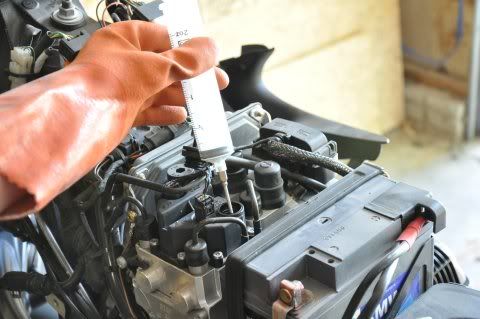


 The only mistake I made was adding too much brake fluid to the front resevoir, thus causing some weeping.