Hydraulic Clutch FLUID
Moderator: Moderators
-
Shaggy 473

- Basic User
- Posts: 30
- Joined: Fri Nov 22, 2013 12:21 pm
Hydraulic Clutch FLUID
Does anyone recommend using Mineral Oil or Automatic Transmission fluid in lieu of brake fluid DOT4 in the hydraulic clutch?
2002 BMW R1150R
1999 Kawasaki KLR650 70,000 Miles
2006 Honda CRF450R
1999 Kawasaki KLR650 70,000 Miles
2006 Honda CRF450R
-
towerworker

- Lifer
- Posts: 2371
- Joined: Sun Jan 08, 2006 8:11 pm
- Location: Staunton Virginia
Re: Hydraulic Clutch FLUID
I've never heard that mentioned before. Why do you ask?
Re: Hydraulic Clutch FLUID
Later bikes from BMW went to the mineral oil. R1150R must use DOT-4.
Buckster '03R
#543
#543
-
Shaggy 473
- Basic User
- Posts: 30
- Joined: Fri Nov 22, 2013 12:21 pm
Re: Hydraulic Clutch FLUID
I was told that the DOT4 fluid is corrosive and could damage the slave cylinder.
2002 BMW R1150R
1999 Kawasaki KLR650 70,000 Miles
2006 Honda CRF450R
1999 Kawasaki KLR650 70,000 Miles
2006 Honda CRF450R
-
towerworker
- Lifer
- Posts: 2371
- Joined: Sun Jan 08, 2006 8:11 pm
- Location: Staunton Virginia
Re: Hydraulic Clutch FLUID
What is corrosive is the moisture that will accumulate over time when the recommended fluid change interval is not followed. Brake fluid will eventually absorb enough water to cause the corrosion. It's not the fluid itself but the contamination that eventually follows. Really need to follow BMW's maintenance schedule.
The Older I Get, The Less I know. (in honor of MikeCam
'05 RT
'04 R
'03 R
CB750
KZ750
HD 350 Sprint
'05 RT
'04 R
'03 R
CB750
KZ750
HD 350 Sprint
-
CycleRob

- Honorary Lifer
- Posts: 2857
- Joined: Mon Mar 21, 2005 12:29 am
- Location: Enjoying retirement in Gainesville GA. USA
- Contact:
Re: Hydraulic Clutch FLUID
Shaggy 473, Our friend Towerworker is right about everything. Harley-Davidson changed over to the purple tinted full synthetic DOT5 oil long ago and 'experts' noted that system seals need to be different from DOT3/4 designs. I would say that still applies to all other non-DOT4 "oils".
What I also found out is that that the OilHead slave cylinder has a service life that is shorter than near identical DOT3 systems on many Japanese bikes, possibly because the car type dry clutch requires a higher actuation force to release it -and- there is NO running slave/pushrod/clutch freeplay when the OilHead clutch lever is fully released. The relatively strong internal slave piston spring makes any freeplay less than zero. That steady spring pressure means the slave piston's tiny, sealed ball bearing is always spinning under an axial load whenever the engine is running. Shaggy 473, your 2002 model very likely does not have it's original clutch slave assembly. With your bike's 14 years of age I recommend you take the time to remove and completely disassemble the slave and the master cylinder for cleaning. Just be sure to remove and isolate any rubber seals before using the spray brake cleaner!!
Everyone well north of the equator is now in degrees of winter with weeks/months of rider down time. I seriously advise you to put that down time to good use with an off schedule DOT4 clutch (and brake?) servicing . . . . serious enough for this detailed post. You'll have plenty of time to order, wait for, and then install the replacement parts IF needed. What follows was extracted and modified from my very old slave bleeding post, so you can quickly service a cleaned/new/dry slave system:
Bleeding the clutch slave is very easy, even with the entire system brand new clean, dry -and- with no special bleeding equipment available to you. What has to understood is that air and air bubbles always want to float upward when submerged in liquids and trying to force tiny air bubbles downward to the bleeder hose can be an exercise in futility. Put the bike on the centerstand, then with a helper, tilt the bike over enough, each way, to sequentially insert a one inch thick board under each centerstand foot so that the rear wheel is 3+ inches (76+mm) higher than the front wheel. That front down tilted position (Remove the bags and trunk!) ensures that any air bubbles will go to the rear of the slave cylinder internal body, where the bleeder is located. Next, turn and secure the steering to the right steering stop, effectively orienting the tiny bleedback hole at the bottom of the Master Cylinder (MC) is now higher than the attached Banjo bolt line fitting. Then you fill the empty MC reservoir to 3/4 full from the reservoir's top opening "spill over point" and open the bleeder with an attached bleeder hose dunked in a container. Now, if the MC is clean and the lever freeplay is adjusted properly, it should (VERY) slowly partially drain into the slave chamber by gravity. It also may not. That is when you SLOWLY squeeze the lever in, a short distance until minute pumping resistance is first felt, and fully out, 7+ times, to purge tiny air bubbles out the MC reservoir's tiny bleedback hole. Then try a bleeding routine, pumping mostly air, with different pause times:
1--Open bleeder.
2--Squeeze lever to bar and hold 5 seconds.
3--Close bleeder
4--Release lever quickly and wait 5 seconds.
5--Repeat
Those 5 second wait times allow very low pressure air to move thru small bleeder fitting openings. Watch the reservoir fluid level and use the rectangular lid's attached rubber bellows to cap any lever induced upward fluid spurts. Once you feel resistance that shows the clutch is releasing, it says that most of the air has been expelled. Do this:
1--With the steering held to the right steering stop, bleeder closed, slowly squeeze the clutch lever to the bar.
2--Release lever quickly and wait 5 seconds for air bubbles to combine
3--Cycle the clutch lever in-n-out within the very short freeplay zone before pumping pressure starts 5+ times, to allow any hidden air bubbles to go Up-n-Out the MC reservoir bleedback hole. You will see them bubbling up thru the liquid until steps 1 to 3 generate less and less air bubbles until there are none . . . only liquid moves the standing fluid surface.
4--Bleed the slave cylinder like this:
a--Squeeze lever to the bar and hold it there.
b--Rapidly open bleeder then close it.
c--Release lever then repeat from step (a).
5--Using the bleeder to cycle the slave piston in-and-out helps purge air and older trapped fluid.
6--When air bubbles stop, you are done!
Some thumbs for you to load pics for clarification.
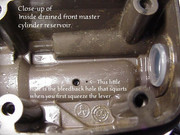
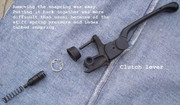
What I also found out is that that the OilHead slave cylinder has a service life that is shorter than near identical DOT3 systems on many Japanese bikes, possibly because the car type dry clutch requires a higher actuation force to release it -and- there is NO running slave/pushrod/clutch freeplay when the OilHead clutch lever is fully released. The relatively strong internal slave piston spring makes any freeplay less than zero. That steady spring pressure means the slave piston's tiny, sealed ball bearing is always spinning under an axial load whenever the engine is running. Shaggy 473, your 2002 model very likely does not have it's original clutch slave assembly. With your bike's 14 years of age I recommend you take the time to remove and completely disassemble the slave and the master cylinder for cleaning. Just be sure to remove and isolate any rubber seals before using the spray brake cleaner!!
Everyone well north of the equator is now in degrees of winter with weeks/months of rider down time. I seriously advise you to put that down time to good use with an off schedule DOT4 clutch (and brake?) servicing . . . . serious enough for this detailed post. You'll have plenty of time to order, wait for, and then install the replacement parts IF needed. What follows was extracted and modified from my very old slave bleeding post, so you can quickly service a cleaned/new/dry slave system:
Bleeding the clutch slave is very easy, even with the entire system brand new clean, dry -and- with no special bleeding equipment available to you. What has to understood is that air and air bubbles always want to float upward when submerged in liquids and trying to force tiny air bubbles downward to the bleeder hose can be an exercise in futility. Put the bike on the centerstand, then with a helper, tilt the bike over enough, each way, to sequentially insert a one inch thick board under each centerstand foot so that the rear wheel is 3+ inches (76+mm) higher than the front wheel. That front down tilted position (Remove the bags and trunk!) ensures that any air bubbles will go to the rear of the slave cylinder internal body, where the bleeder is located. Next, turn and secure the steering to the right steering stop, effectively orienting the tiny bleedback hole at the bottom of the Master Cylinder (MC) is now higher than the attached Banjo bolt line fitting. Then you fill the empty MC reservoir to 3/4 full from the reservoir's top opening "spill over point" and open the bleeder with an attached bleeder hose dunked in a container. Now, if the MC is clean and the lever freeplay is adjusted properly, it should (VERY) slowly partially drain into the slave chamber by gravity. It also may not. That is when you SLOWLY squeeze the lever in, a short distance until minute pumping resistance is first felt, and fully out, 7+ times, to purge tiny air bubbles out the MC reservoir's tiny bleedback hole. Then try a bleeding routine, pumping mostly air, with different pause times:
1--Open bleeder.
2--Squeeze lever to bar and hold 5 seconds.
3--Close bleeder
4--Release lever quickly and wait 5 seconds.
5--Repeat
Those 5 second wait times allow very low pressure air to move thru small bleeder fitting openings. Watch the reservoir fluid level and use the rectangular lid's attached rubber bellows to cap any lever induced upward fluid spurts. Once you feel resistance that shows the clutch is releasing, it says that most of the air has been expelled. Do this:
1--With the steering held to the right steering stop, bleeder closed, slowly squeeze the clutch lever to the bar.
2--Release lever quickly and wait 5 seconds for air bubbles to combine
3--Cycle the clutch lever in-n-out within the very short freeplay zone before pumping pressure starts 5+ times, to allow any hidden air bubbles to go Up-n-Out the MC reservoir bleedback hole. You will see them bubbling up thru the liquid until steps 1 to 3 generate less and less air bubbles until there are none . . . only liquid moves the standing fluid surface.
4--Bleed the slave cylinder like this:
a--Squeeze lever to the bar and hold it there.
b--Rapidly open bleeder then close it.
c--Release lever then repeat from step (a).
5--Using the bleeder to cycle the slave piston in-and-out helps purge air and older trapped fluid.
6--When air bubbles stop, you are done!
Some thumbs for you to load pics for clarification.
Last edited by CycleRob on Wed Jul 24, 2019 9:43 pm, edited 1 time in total.
`09 F800ST
Member since Sept 10, 2001
"Talent, On Loan, From God" --Rush Limbaugh--
Member since Sept 10, 2001
"Talent, On Loan, From God" --Rush Limbaugh--
-
Shaggy 473
- Basic User
- Posts: 30
- Joined: Fri Nov 22, 2013 12:21 pm
Re: Hydraulic Clutch FLUID
Thanks for all the information; where can I buy the bleeder?
I saw one video where you can just depress the "bleed ball" with any blunt object like a allen key.
I saw one video where you can just depress the "bleed ball" with any blunt object like a allen key.
2002 BMW R1150R
1999 Kawasaki KLR650 70,000 Miles
2006 Honda CRF450R
1999 Kawasaki KLR650 70,000 Miles
2006 Honda CRF450R
-
AZBMWRIDER
- Basic User
- Posts: 348
- Joined: Tue Oct 08, 2013 3:43 pm
- Location: Tempe, Aridzona
Re: Hydraulic Clutch FLUID
I bought a BMW bleeder screw to bleed the clutch , this was October, 2004 .
BMW P/N : 34 21 2 330 310 .
Looks to be still a good part number .
You need to remove the grub screw that is installed, from what I can remember, it was a straight slot set screw type of part .
Don't know know accurate the price is, looks like $10.98 .
http://www.realoem.com/bmw/enUS/showpar ... 4212330310
Item # 12 .
BMW P/N : 34 21 2 330 310 .
Looks to be still a good part number .
You need to remove the grub screw that is installed, from what I can remember, it was a straight slot set screw type of part .
Don't know know accurate the price is, looks like $10.98 .
http://www.realoem.com/bmw/enUS/showpar ... 4212330310
Item # 12 .
'02 R1150R, Atlanta Blue
Been riding since 1979, BMW's since 1981 .
4 R65's, '87 Guzzi V65 Lario .
Been riding since 1979, BMW's since 1981 .
4 R65's, '87 Guzzi V65 Lario .
-
CycleRob
- Honorary Lifer
- Posts: 2857
- Joined: Mon Mar 21, 2005 12:29 am
- Location: Enjoying retirement in Gainesville GA. USA
- Contact:
Re: Hydraulic Clutch FLUID
Shaggy 473,
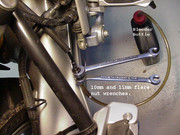
The bleeder you need is a BMW part number that I believe fits an older model rear brake caliper. It replaces the entire factory proprietary bleeder check valve assembly screwed onto the end of the bleeder line. To prevent the reservoir fluid from siphoning while you disconnect things, hold the clutch lever partially depressed with a rubber band. BTW that factory bleeder assembly has (semi permanent) red Loctite on the threads attaching it to the bleeder line. That Red epoxy needs a fast high heat application to soften it to a gooey paste so you can loosen it. The heat needs to be applied quickly and focused on the bleeder body close to the fitting so the heat is not conducted into the plastic and rubber part of the bleeder line. I used a 10" ViseGrip's intentionally HARD bite-mark-leaving-grip to hold onto the free end of the black painted Aluminium body of the (expendable) factory bleeder -AND- an 11mm flare nut wrench on the bleeder line nut to loosen it. If you use an open end or adjustable wrench on that nut you have a very good chance of crushing it out of shape . . . then it may crack during attempts to true it up again and/or will not work well with the new bleeder fitting. I used a very wet rag wrapped around the line, touching the flare nut wrench mounted on the hex nut fitting and then used the tip of the inner blue flame to hit the Aluminium cylindrical bleeder near the line nut fitting for about 8 seconds. Put down the torch and try to loosen the nut with the flare nut wrench while holding on tightly to the attached ViseGrip. If it does not loosen, quickly add another 4 seconds of heat and try to loosen it again.
When you obtain the new fitting, lightly grease the male threads to lessen the chance of galling the Aluminium threads after many loosen-tighten-loosen sequences as you bleed the slave. Use very low torque when you tighten the bleeder during the bleeding process and medium torque for the final one. Be very aware that greasing the threads LOWERS the torque required by about 30 percent to obtain the proper torque . . . so do NOT over-tighten a greased fitting! After bleeding, squeeze-and-hold the clutch lever for a minute plus to check that the solvent cleaned bleeder opening is not leaking DOT4 fluid.
The bleeder you need is a BMW part number that I believe fits an older model rear brake caliper. It replaces the entire factory proprietary bleeder check valve assembly screwed onto the end of the bleeder line. To prevent the reservoir fluid from siphoning while you disconnect things, hold the clutch lever partially depressed with a rubber band. BTW that factory bleeder assembly has (semi permanent) red Loctite on the threads attaching it to the bleeder line. That Red epoxy needs a fast high heat application to soften it to a gooey paste so you can loosen it. The heat needs to be applied quickly and focused on the bleeder body close to the fitting so the heat is not conducted into the plastic and rubber part of the bleeder line. I used a 10" ViseGrip's intentionally HARD bite-mark-leaving-grip to hold onto the free end of the black painted Aluminium body of the (expendable) factory bleeder -AND- an 11mm flare nut wrench on the bleeder line nut to loosen it. If you use an open end or adjustable wrench on that nut you have a very good chance of crushing it out of shape . . . then it may crack during attempts to true it up again and/or will not work well with the new bleeder fitting. I used a very wet rag wrapped around the line, touching the flare nut wrench mounted on the hex nut fitting and then used the tip of the inner blue flame to hit the Aluminium cylindrical bleeder near the line nut fitting for about 8 seconds. Put down the torch and try to loosen the nut with the flare nut wrench while holding on tightly to the attached ViseGrip. If it does not loosen, quickly add another 4 seconds of heat and try to loosen it again.
When you obtain the new fitting, lightly grease the male threads to lessen the chance of galling the Aluminium threads after many loosen-tighten-loosen sequences as you bleed the slave. Use very low torque when you tighten the bleeder during the bleeding process and medium torque for the final one. Be very aware that greasing the threads LOWERS the torque required by about 30 percent to obtain the proper torque . . . so do NOT over-tighten a greased fitting! After bleeding, squeeze-and-hold the clutch lever for a minute plus to check that the solvent cleaned bleeder opening is not leaking DOT4 fluid.
`09 F800ST
Member since Sept 10, 2001
"Talent, On Loan, From God" --Rush Limbaugh--
Member since Sept 10, 2001
"Talent, On Loan, From God" --Rush Limbaugh--