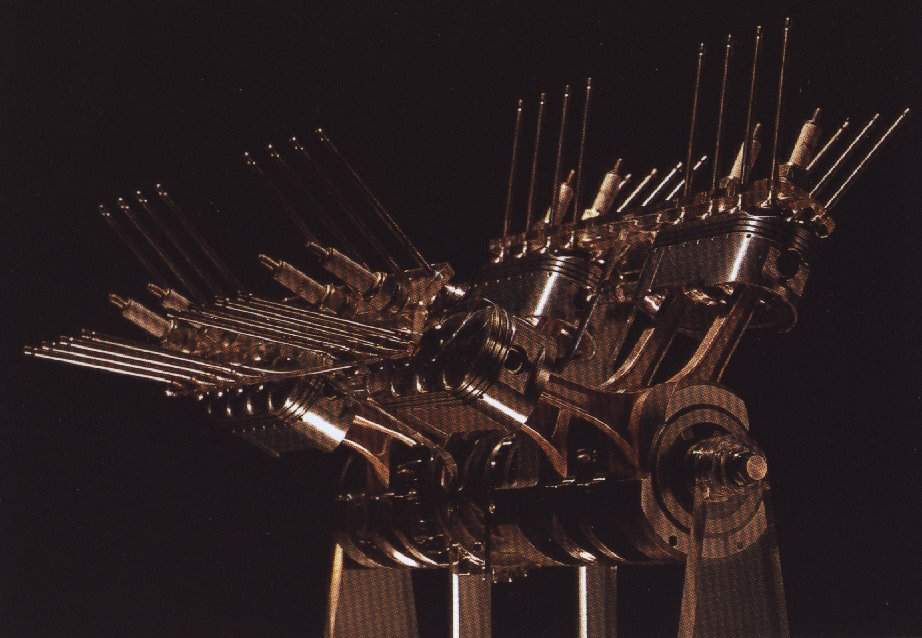
Honda's NR-500, or...
How do you compete when the rules are set against you?
Well, you can just follow the trend and do what everyone else is doing, or you can try and alter time and physics, and do it with sheer force of creativity and will... Sometimes it works, and a fairy tale story is written about it. Other times, well...
It doesn't work out so wonderfully and so it just sort of quietly fades away, never really receiving the attention it deserves. Such is one of the saddest, yet utterly fascinating, stories in all of motorcycling history - Honda's NR-500.
The premier series in motorcyle GP racing in the late 1970's was the 500cc class, and it was dominated by two-strokes. Honda had left with its four-strokes back in 1968, and though MV Agusta carried on the fight against the ring-ding onslaught even it finally succumbed. Thus the field was left to primarily Yamaha and Suzuki two-strokes. These were certainly incredible machines in their own right, but there were still those who wished a four-stroke could compete again. Problem was, two-strokes had a distinct advantage...
Though a two-stroke is not the highest on the volumetric efficiency scale, it has one wonderful attribute... It gets a power stroke on every single rotation of the crankshaft per cylinder. A four-stroke only gets one every *OTHER* rotation of the crank per cylinder. This is a very real problem for the four-stroke by comparison, because for any given unit of time (provided RPM is the same) the two-stroke gets twice as many power impulses. In other words, it gets to apply its motive force twice as often. Two-strokes also have considerably less internal friction than four-strokes.
Now, back in the 1960's Honda scared the FIM silly with its 250cc six, and sensing that one could suddenly have a bunch of six and eight cylinder GP bikes, two-stroke or four, bothered them primarily for cost reasons, so they made a rule limiting the 500cc class to no more than four cylinders. This also chucked a rock against ever having a four-stroke in the premier class. See, it is obvious that one way a four-stroke could compete against a two-stroke is simply to have twice as many cylinders - i.e. an 8-cylinder four-stroke would have the same number of power impulses per rotation of the crankshaft as a two-stroke 4-cylinder.
Now is where we get Honda back into this story. Honda truly wanted to race in the 500 GP's again in the late 1970's, but they wanted to do it with a four-stroke. Honda saw the end of the two-stroke for street machines due to worldwide emissions concerns, and they felt they should be using racing to develop what they sold the most of. They felt racing should serve street bike development, not just be development in and for itself, which is where two-stroke development was heading. Very quietly, in approximately 1975 or '76 Honda started petitioning the FIM to allow four-strokes to have 8-cylinders for the 500cc class, reasoning they could overcome the frictional losses of the four-stroke if they could just get the same number of power impulses per crank rotation...
There is actually more to it than that, though... Engines are nothing more than air pumps, and the more air you can pump in any given unit of time, the more power you can produce. Four-strokes have one great advantage over two-strokes... They don't have to move their mixture very far... Just down the intake tract directly into the combustion chamber. Two-strokes have to move it down into the crankcase (either via piston port, case reeds, rotary valves, or the like), then up the tranfer ports into the combustion chamber. It is this distance the fuel-air charge must travel that limits a two-stroke's RPM depending on the engine's size... A little, tiny two-stroke can rev really high because the distances are short, but a big two-stroke can't rev very high because the distance is far longer...
An important point to remember... You cannot move the fuel-air charge faster than the speed of sound. It's physically impossible. The proof of it is too long to go into here, so trust me... It can't be done. Therefore, you can only move a column of fuel-air charge so far in any given unit of time, and this is what limits two-strokes upper rev ranges.
Anyway, back to Honda and the FIM... Honda knew if they could get eight cylinders past the FIM then they might actually have an advantage over the two-strokes. Sure, they would have weight to contend with, and more friction, and some other issues to solve, but Honda saw none of those as insurmountable.
But the FIM kept rejecting their petitions... Nope, four cylinders was the limit - two-stroke or four - and that was the end of it. The FIM has never been too good at foresight, and this was a classic example. They should have gladly welcomed Honda's petition and got them back in the game right away. They could always change the rules again later if Honda upset the apple cart, but no...
Well, Honda was left with a dilemma, and a decision... Do we persist with this four-stroke stubborness, or do we just throw in the towel and develop a two-stroke until we can get the FIM to change the rules from the inside?
In typical Honda fashion, they did both, and sometime in around 1977 Honda set up two teams... One to develop a four-stroke GP bike, and one team to develop a two-stroke. This was only the beginning, and the result would be political intrigue and infighting that would do justice to a cheap thriller novel... and it would lead to one of the most fascinating engines ever devised by man...
The NR-500...

(to be continued)
Cheers!
Dallara