Page 1 of 5

A Sad But Fascinating Story - Honda's NR-500

Posted: Sun Nov 13, 2005 8:47 pm
by dallara
(First off, please understand that most all of this is being drawn from my memory... I promise you it is pretty friggin' accurate, but I might miss a detail or two. If you spot an error, please post the correction. I need all the help I can get...)

Honda's NR-500, or...

How do you compete when the rules are set against you?

Well, you can just follow the trend and do what everyone else is doing, or you can try and alter time and physics, and do it with sheer force of creativity and will... Sometimes it works, and a fairy tale story is written about it. Other times, well...

It doesn't work out so wonderfully and so it just sort of quietly fades away, never really receiving the attention it deserves. Such is one of the saddest, yet utterly fascinating, stories in all of motorcycling history - Honda's NR-500.

The premier series in motorcyle GP racing in the late 1970's was the 500cc class, and it was dominated by two-strokes. Honda had left with its four-strokes back in 1968, and though MV Agusta carried on the fight against the ring-ding onslaught even it finally succumbed. Thus the field was left to primarily Yamaha and Suzuki two-strokes. These were certainly incredible machines in their own right, but there were still those who wished a four-stroke could compete again. Problem was, two-strokes had a distinct advantage...

Though a two-stroke is not the highest on the volumetric efficiency scale, it has one wonderful attribute... It gets a power stroke on every single rotation of the crankshaft per cylinder. A four-stroke only gets one every *OTHER* rotation of the crank per cylinder. This is a very real problem for the four-stroke by comparison, because for any given unit of time (provided RPM is the same) the two-stroke gets twice as many power impulses. In other words, it gets to apply its motive force twice as often. Two-strokes also have considerably less internal friction than four-strokes.

Now, back in the 1960's Honda scared the FIM silly with its 250cc six, and sensing that one could suddenly have a bunch of six and eight cylinder GP bikes, two-stroke or four, bothered them primarily for cost reasons, so they made a rule limiting the 500cc class to no more than four cylinders. This also chucked a rock against ever having a four-stroke in the premier class. See, it is obvious that one way a four-stroke could compete against a two-stroke is simply to have twice as many cylinders - i.e. an 8-cylinder four-stroke would have the same number of power impulses per rotation of the crankshaft as a two-stroke 4-cylinder.

Now is where we get Honda back into this story. Honda truly wanted to race in the 500 GP's again in the late 1970's, but they wanted to do it with a four-stroke. Honda saw the end of the two-stroke for street machines due to worldwide emissions concerns, and they felt they should be using racing to develop what they sold the most of. They felt racing should serve street bike development, not just be development in and for itself, which is where two-stroke development was heading. Very quietly, in approximately 1975 or '76 Honda started petitioning the FIM to allow four-strokes to have 8-cylinders for the 500cc class, reasoning they could overcome the frictional losses of the four-stroke if they could just get the same number of power impulses per crank rotation...

There is actually more to it than that, though... Engines are nothing more than air pumps, and the more air you can pump in any given unit of time, the more power you can produce. Four-strokes have one great advantage over two-strokes... They don't have to move their mixture very far... Just down the intake tract directly into the combustion chamber. Two-strokes have to move it down into the crankcase (either via piston port, case reeds, rotary valves, or the like), then up the tranfer ports into the combustion chamber. It is this distance the fuel-air charge must travel that limits a two-stroke's RPM depending on the engine's size... A little, tiny two-stroke can rev really high because the distances are short, but a big two-stroke can't rev very high because the distance is far longer...

An important point to remember... You cannot move the fuel-air charge faster than the speed of sound. It's physically impossible. The proof of it is too long to go into here, so trust me... It can't be done. Therefore, you can only move a column of fuel-air charge so far in any given unit of time, and this is what limits two-strokes upper rev ranges.

Anyway, back to Honda and the FIM... Honda knew if they could get eight cylinders past the FIM then they might actually have an advantage over the two-strokes. Sure, they would have weight to contend with, and more friction, and some other issues to solve, but Honda saw none of those as insurmountable.

But the FIM kept rejecting their petitions... Nope, four cylinders was the limit - two-stroke or four - and that was the end of it. The FIM has never been too good at foresight, and this was a classic example. They should have gladly welcomed Honda's petition and got them back in the game right away. They could always change the rules again later if Honda upset the apple cart, but no...

Well, Honda was left with a dilemma, and a decision... Do we persist with this four-stroke stubborness, or do we just throw in the towel and develop a two-stroke until we can get the FIM to change the rules from the inside?

In typical Honda fashion, they did both, and sometime in around 1977 Honda set up two teams... One to develop a four-stroke GP bike, and one team to develop a two-stroke. This was only the beginning, and the result would be political intrigue and infighting that would do justice to a cheap thriller novel... and it would lead to one of the most fascinating engines ever devised by man...

The NR-500...

Image

(to be continued)

Cheers!

Dallara

Posted: Sun Nov 13, 2005 8:54 pm
by JCsman
Dallara:

Have you ever considered writing a book? (Maybe you have, if so give me a title to search for).

You tell a tale well. You have a grasp of the key AND interesting aspects. You know the technology and can put it in words for the non-gearhead. And you have the "Hell, I was there" factor in spades.

Publish one and I can guarentee at least one sold in the great state of Alabama. :wink:

Okay, where were we...

Posted: Sun Nov 13, 2005 9:34 pm
by dallara
Okay, where were we...

Oh, yeah - we left off with Honda assigning two teams for 500cc GP bike development... One for a four-stroke and one for a two-stroke. Now for the moment we are going to concetrate on the four-stroke development team, as that is where the subject of this article came from - the NR-500. However, the two-stroke team will crop up from time to time, as you will see.

Now the team set to develop Honda's possible four-stroke contender was, as is usual for Honda, a group of fresh, young, enthusiastic engineers right out of school. but it was led by one of the most brilliant engine designers Honda ever had - Shoichiro Irimajiri. You may have heard his name before. He was the designer of some of Honda's most successful GP racers of the 1960's - most notably the wailing 250cc, 21,000 RPM, six-cylinder RC-166. Actually, to say Irimajiri was brilliant is a bit of an understatement. Jedi Master of all things internal combustion is more like it. And Irimajiri's best attribute... He thought outside the "box".

Honda's four-stroke team had to figure out how to get the same amount of fuel-air mix though a four-cylinder as they would move through an eight-cylinder, and then they had to also figure out how to do it so their engine would have as many power impulses in any given unit of time as a two-stroke four-cylinder... Two seemingly vexing and impossible tasks. But not for Irimajiri.

Getting the same number of power impulses per unit of time was the easy part... He would simply spin the engines twice as fast as the two-strokes, much like he had back in the 1960's... Most of the two-stroke 500cc GP bikes at the time were making max power at about 9,000 to 10,000 RPM, with some pulling it as low as 8,500. All he would have to do is spin his four-stroke 500 at least 20,000 RPM. However, due to frictional losses, he would probably have to shoot for more like 21,000, but that didn't seem to out of the realm of possibility. Granted, they had never spun a 500cc GP four that fast back in the 1960's, with the all-conquering RC-181 of that time turning only 12,000 (but capable of bursts up to 14,000), but he spun the 250 sixes over 20,000, and metalurgy, materials, etc. had come a long way. He was sure he could do it...

The problem was how do you move as much fuel-air mix as an 8-cylinder when you only have four cylinders? How do I get the same valve area, yet maintain the port velocity, of an 8-cylinder when I only have four to work with?

It is said Shoichiro Irimajiri came up with the solution while sitting in a traffic jam in his native Japan. It seems the traffic signal lights where he was at had oval-shaped lights... And that's when the ligth bulb went off in his head!

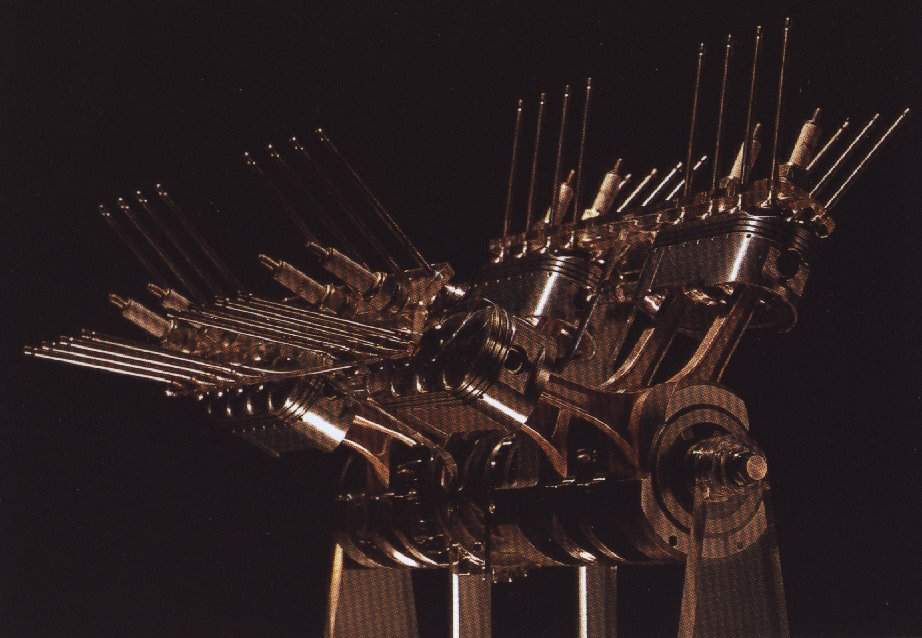
If he made the cylinders oval in shape, he could pack in the same eight valves (four intake and four exhaust) into one cylinder of his 4-cylinder he would have had in two cylinders of an 8-cylinder engine, and he would have equivalent piston area as compared to stroke of the 8-cylinder. So, he would have his necessary port velocity, the same valve area he would have had with an 8-cylinder, and since he was going to spin it twice as fast he would get his power impulses, too, along with pumping the necessary amount of air over time! Essentially he would have his V-8, only every two pair of cylinders would be siamesed together... :shock:

There was only one problem...

Nobody had ever built a successful oval-piston engine before. Why? Because this one problem has its source in a myriad of other problems...

How do you seal the rings? Can one connecting rod adequately control the thrust loadings of an oval piston? How do you readily machine oval bores? What would combustion dynamics and flame front propogation be like in an oval combustion chamber?

But, hey... He had found the solution. Now all he needed to do was solve the problems and build it... :D

Image


(To be continued)


Cheers!

Dallara

Sensei Irimajiri and his band of Samurai...

Posted: Sun Nov 13, 2005 11:26 pm
by dallara
Well, when we last left off our engine Sensei, Shoichiro Irimajiri, had just had the enlightening insight to solve all his goals... an oval-pistoned engine.

This really was an elegant solution if he could make it work, and the idea seemed so simple. More than that, it had far, far reaching implications. In fact, such an engine could completely change the face of internal combustion four-strokes, and not just in racing... that is *IF* the fundamental problems could be overcome.

He presented his idea to his team of young engineers and they greeted the challenge with enthusiasm. An engine of this type was easy to draw up, but producing it would be another matter... Entirely new machining operations would have to be designed, and no one really knew about the expansion qualities of an oval piston, or an oval bore, so clearancing would be uncharted territory...

First off was to get some drawings done and the necessary patents filed. If Honda could make this engine work, and it achieved what they hoped it would, it could be a boon to them to have the design as "locked up" as possible for numerous reasons. It would give them an "exclusive" for quite a while, but they could license the technology if they chose to. Patents were filed for in March of 1978, but by then engines were actually running on the dyno, though in complete secrecy. By this time the development of the oval piston engine was consuming enormous resources in not only materials and development money, but in design staff as well. See, Honda not only had to design the engine, but design the tools to build it, and come up with manufacturing techniques that had never been done before. This is where the first part of the political infighting inside the company began...

First to suffer was the two-stroke design team. Their project was essentially brought to a halt so much of their original team could be used on the four-stroke NR. This didn't sit too well with some of them, as they had confidence in their design (and they had every right to be confident, as it turns out... Their designs would eventually win world championships, but that's another story - the NS-500 V-3 and NSR-500 V-4 story - for another time!). Still they were called to the four-stroke project and put to work on it. This later lead to one of the problems with the NR-500 project. Usually a small team would work on a design at Honda, and work on the total design, front to back. This was not the case with the NR. Design groups were segregated, and some of them did not even know what other design groups on the project were doing... Such was the ironclad veil of secrecy Honda was trying to keep on the engine and its support systems. This is why one analyst once said that "The Honda NR-500 looks and runs like it was designed by a committee, because it was designed by a committee."

One of the other issues with the project was that Honda was really swinging for the fence in every area of motorcycle design. They weren't just being satisfied with comoing up with an all-new, incredibly radical, cutting edge engine design... They also wanted an equally new and radical chassis, suspension, ignition and fuel control subsystem, cooling set-up, and aerodynamic design... Even the wheels and brakes were meant to break new ground. This was far different from how they entered motorcycle GP racing in the past, where they went with fairly conventional designs and evolved them into radical, cutting edge pieces. No, this was trying to have it all at once... And it would hog-tie the NR-500 right from the beginning. But more on this later...

One of the problems that began to look like it had no solution was cylinder sealing... It seemed no piston ring design was capable of retaining its ability to seal much after it went through two or three heat cycles. Now it is important to remember that Soichiro Honda started out producing pistons and piston rings with his first company - ART. Pick up a Honda piston sometime. Chances are you will see the letters "ART" still lightly cast in it somewhere.

Point is, if anybody knew about piston rings, it was Honda. They finally licked the problem, but only have it took an enormous amount of time and considerable resources robbed from other projects. By now half of Honda's development department was fed up with the NR project... The other half was working on it! Honda wanted the bike ready for the 1979 season, but as that began to look more and more unlikely Honda simply assigned more people to the project and threw more money at it.

Well, that worked... though not as it was supposed to, because though the NR-500 was completed on time for its promised debut, it had undergone almost no testing. It would be tested on the racetrack, in full view of the public...

It would not be a pretty sight...

Still, the bike was interesting from a technological standpoint. At the time of its debut littel was said, or known about the internal design of the engine. Honda would only say it had oval-pistons. At first they would not even mention the number of valves, or spark plugs, or anything else.

But anyone could see the chassis, fairing, etc., and that alone was enough to get people's jaws to drop...

Image

Image

Image

You certainly couldn't call it "pretty", but it was different... 16" wheels front and rear, back at a time when everyone else was running on 18" rims... And these wheels weren't cast or a conventional spoke wheel, either, but a special lightweight version of Honda's "Comstar" wheel using an extruded rim, forged aluminum spokes, and cast magnesium hubs - all literally bolted together. The chassis itself was the most arresting part of the design. It was a carbon-fiber monoque, back before anyone had tried anything like that before. The rear suspension was pretty conventional with a monoshock design that resembled Yamaha's at the time, but the front forks were just plain weird!

They sort of looked like conventional forks, but the springs were carried externally on spring posts mounted ont he front of the forks, with conventional (though upside-down... something else new at the time) sliders behind them. Incorporating into all this was a rather strange anti-dive set-up. but weirdest of all was the placement of the disc brake calipers way out on the front of the forks... Just about everybody knew that locating the calipers behind the fork legs, where they were near the axis of steering rotation, was a proper solution as it lessened steering effort and reduced the polar rotational moment... Why would Honda put the calipers there, everyone asked?

In fact, all the bike did was raise questions... Why the calipers up there? Why mount the front springs externally? Why the little 16" wheels? Why the "built-up" wheel design? Why mount the radiators on the sides? Why the strange little windscreen? How could the fairing be part of the chassis? What was inside the engine?

Everyone would have to wait for Silverstone in August of 1979 to find out...

Image


(To be continued)

Cheers!

Dallara

Posted: Mon Nov 14, 2005 8:15 am
by boxermania
Dallara, it has been proven time after time that when it comes to motorcycle trivia you are DA MAN.

I wonder if there is an economic gain to be had from that wonderfull knowledge.....have you thought about it?......if not and since I brought it to your attention, I want a cut if you decide to pursue it.

After all I praised you as well as brought it to your attention, on the same post....... :roll: :roll:

Posted: Mon Nov 14, 2005 9:45 am
by scottybooj
and then?

It's coming, Scotty...

Posted: Mon Nov 14, 2005 9:52 am
by dallara
The rest of the story is coming, Scotty...

Will have to be this evening though. Gotta' do at least some work today... :lol:

One interesting part of the NR-500 story, however... Is that it actually hasn't ended even up to today... It goes right through the little known "NR-650"... right ot the NR-750 endurance racers and NR-750 production model... and even right up to the current RCV-211...

Not to mention perhaps right on into 2007... :wink:

But that's getting ahead of the story.

Cheers!

Dallara

Aw, come on...

Posted: Mon Nov 14, 2005 10:43 pm
by dallara
Aw, come on...

Nobody really wants to read, much less listen to or see anything, about this ancient history, do they?

I apologize for taking up the friggin' bandwidth...

Cheers!

Dallara

Posted: Mon Nov 14, 2005 11:43 pm
by NoRRmad
You are such a tease!
:smt088

NSR

Posted: Tue Nov 15, 2005 6:02 am
by Bones
Don't stop here. This is like reading a thriller and the author decides not to write the last couple of chapters.

I was with Freddie Spencer when he was telling some very interesting stories about riding this bike or a version of it. He hated it. He said the only thing he liked about it was that it would destroy itself everytime he rode it, which allowed him to convince Honda to not make him ride it anymore. He said it made NO power until about 16K rpms if I remember correctly, then was like a rocket, then made no power again. The power band was all in about 2K near the top. He said the engine literally melted everything when ridden at race pace, which relieved him of having to ride it for very long.

Keep going! At least to finish this one.

Bones

I dunno', Bones...

Posted: Tue Nov 15, 2005 4:10 pm
by dallara
I dunno', Bones...

I honestly don't think very many really want to hear the story. It's fascinating to me, and maybe to you, but I can always pass it along to you via e-mail or when we meet for a drink one day. I get the feeling most of the folks here are more interested in new bikes, and especially BMW's... Which is essentially how it should be since it is a BMW forum. I can understand how Honda history would be boring to quite a number here, and I want to respect that.

I will say that from what I've heard Freddie isn't exaggerating... Funny, in the time I spent with Freddie in late 1990's I never talk with him about the NR-500... Of course, when I knew him back in the WERA/CRRC days he hadn't ridden it yet. :lol:

Did you know Freddie Spencer actually won a heat race on an NR???

Mick Grant, one of the first development and race riders of the bike, called it a "light switch" - No power, no power, no power... Then *BANG* all at once, and then it signed off just as quick. He also said it had so little flywheel-effect that it had to idle at about 3,000-4,000 RPM just to stay lit, and that quite often it would just "flame out" in mid-corner if the revs weren't kept up...

Most all of this was cured by the time they built the NR-750 endurance racer (not the street NR... Which actually had a proper name of just "NR", not NR-750 as everyone called it). The NR-750 endurance racer was actually quite successful, in a way... It led every race it was ever entered in, and never broke. However, Honda withdrew it prior to the finish of each race it was in (except one, where I believe they left it in, but slowed it down so it wouldn't win, IIRC). They would always list some minor mechanical malady, but the story I heard from some guys in the race department was Honda didn't want it to win for fear it would be outlawed in the class...

Anyway, I can finish the story if anybody wants to hear it here, or pass it on to you privately if no one does.

Cheers!

Dallara

Posted: Tue Nov 15, 2005 5:04 pm
by Kabusa
I am loving this Honda stuff!
Right now this post has 365 visits, 10 replies and not a single complaint! 8)
Wrap this thing up already, while we are still young! :) :) :) :) :) :) :)
If you want, finish it (or continue it forever) in 'off topic'. But direct us there if thats your plan.
And thanks in advance. :wink:

Posted: Tue Nov 15, 2005 11:21 pm
by JCsman
I agree, finish, please.

Posted: Wed Nov 16, 2005 12:58 am
by scottybooj
Dallara, you are such a drama queen!!!! You're just waiting till everyone begs you to finish the dang story!

Listen, we've invested OUR time in reading it, and we thank you for posting it.

Now, get back to it, ok?

Posted: Wed Nov 16, 2005 10:50 am
by geechie
Now, get back to it, ok?
Indeed!

G

No "drama queens" here...

Posted: Wed Nov 16, 2005 11:53 am
by dallara
Sorry, Scotty...

No "drama queens" here. To be quite honest, shortly after I started the NR-500 piece I received a rather unfriendly private message that suggested that I was "wasting the board's time" and trying to turn it into a "Honda forum", etc. I won't mention who sent it, as they know who they are.

It put me off a bit, and made me wonder if anybody really wanted to read this stuff.

Upon further reflection, though, I realized that was just one person's opinion and that if for no one other than myself I should go ahead and finish the piece. So I will, as I have more time this weekend, and finish it here. In the future I will try and open any other non-BMW historical pieces in the "Off Topic" section.

I appreciate all the kind comments, and even the ones that aren't. After all, it's good to have critics... :lol:

I also appreciate the private e-mails (you folks, too, know who you are) with the kind encouragement.

Cheers!

Dallara

Posted: Wed Nov 16, 2005 12:54 pm
by darthrider
Here's what the Index says about the main Forum:
"This is the main section for the R1150R website. Only R1150R (or at least motorycle-based) topics should go in here."
Your thread would appear to be "motorcycle based" to me?!
I received a rather unfriendly private message that suggested that I was "wasting the board's time" and trying to turn it into a "Honda forum", etc. I won't mention who sent it, as they know who they are.
Ahhh, the 'PM' on a topic you disapprove of, what a "safe" way of gouging an individual without exposing yourself to the board!

Keep up the good work Allan. If you think something non-R1150R belongs more on "Off-Topic" than the main board, fine, post there. I'm willing to "waste my time" there are well as here. No diff to me.

And this is coming from someone who is NOT a fan of Honda, has never been, and never will be. But I am a big fan of motorcycles and motorcycle racing, so post on Bro!

Posted: Wed Nov 16, 2005 1:22 pm
by JCsman
Hmmmm... Let's see, I find a thread I don't care anything about. I notice that, periodically it shows back up as having been added to. What to do, what to do.

I could:
1) fire off an angry PM drilling the original poster (and by extension all others who responded), or
2) I could post myself suggesting this be better as an "Off Topic" post, or

I could just not click on the freakin' post!

Thanks, Darth & JCsman...

Posted: Wed Nov 16, 2005 2:15 pm
by dallara
Thanks to both of you, Darth & JCsman...

The line of reasoning you both use, along with some positive e-mail I got, is what convinced me I need to finish the piece.

I appreciate your comments.

Cheers!

Dallara

Posted: Wed Nov 16, 2005 5:26 pm
by Kabusa
Yes!!!!

Dallara, like the Titanic, most of us know what happened with the NR-500 (in the GP series, at least). But your insight and story telling make this post a must read for (just about) any bike nut.
I am looking forward to the rest of the story.